Author of over 45 academic publications (1989-today), encompassing peer-reviewed articles, books, book chapters, and encyclopedia entries. Research is featured in leading academic journals, including the Journal of Tourism Futures, Journal of Hospitality and Tourism Insights, Strategic Change, Journal of Vacation Marketing, and Hospitality & Society. Interdisciplinary focus on the effects of social developments on cultural behaviour. Expertise spans a broad thematic range, transitioning from early work in the sociology of Spanish literature and censorship to contemporary research in strategic foresight, the sharing economy, overtourism, and innovation in higher education.
Books
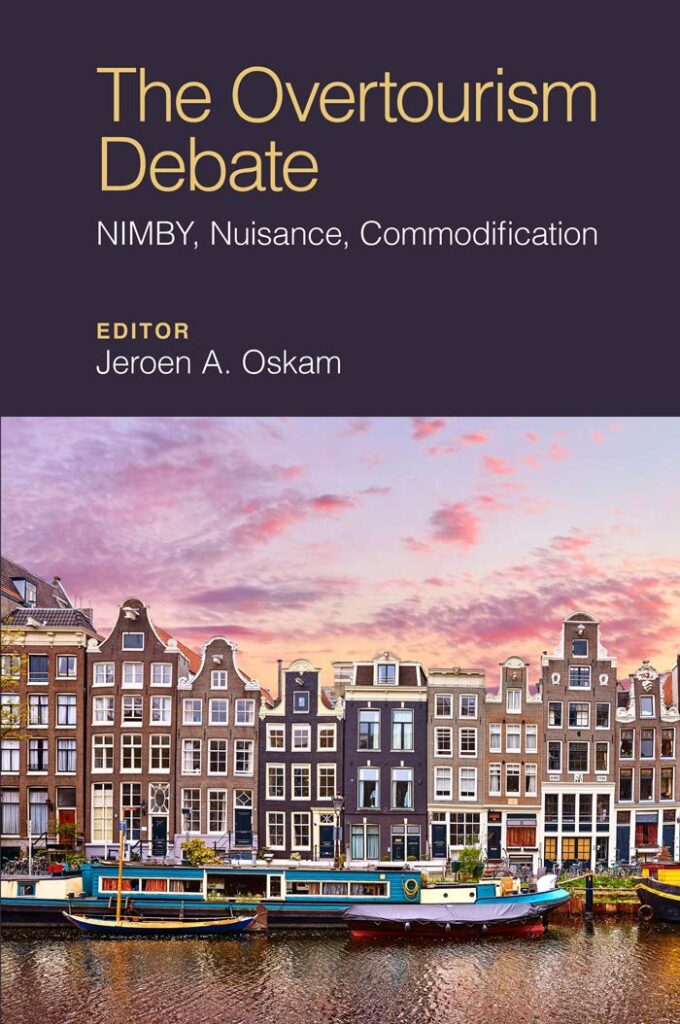


• Oskam, J. (ed.) (2020), The overtourism debate: NIMBY, nuisance, commodification. Bingley: Emerald Publishers.
The purpose of this book is to further the debate on overtourism. Rather than aspiring to present a panorama of case studies about places where overtourism is being discussed, the aim has been to collect a range of studies representing different perspectives in the academic debate. These perspectives concern the theoretical explanations of overtourism, the impacts on our environment and the social reactions that seek to address the phenomenon; all these elements may have a profound influence on our tourist activity, but also on the appearance of the cities in which we live.
https://www.emerald.com/books/edited-volume/12215/The-Overtourism-DebateNIMBY-Nuisance
DOI: https://doi.org/10.1108/9781838674878 | ISBN electronic: 978-1-83867-487-8 | ISBN print: 978-1-83867-488-5 | Publication date: 2020.
• Oskam, J. (2019). The Future of Airbnb and the ‘Sharing Economy’. The Collaborative Consumption of Our Cities. Bristol: Channelview.
In 2018 I was invited by the world’s first “crystal ball gazer” in tourism, Ian Yeoman, and his co-editor Una McMahon-Beattie to write a book in their new series on The Future of Tourism. I had been studying Airbnb for a few years with the futures view Ian had introduced me to. And although it is always good to see that one’s analyses and argumentations have made sense, in the case of Airbnb (and other urban vacation rentals) this has become a very bitter “told you so”.
In 2015 I had invited a mixed group of researchers and practitioners to discuss something cool: the Airbnb trend, its appeal to travellers, and its future evolution. This seems not too long ago, but remember the context: urban tourism was still hardly controversial, a millennial generation was said to have adopted an anti-consumerist attitude to possessions and Amsterdam had declared itself a “sharing city”.
However, in the course of this first research the social climate started changing. The development of Airbnb in New York had already got out of hand, as had been demonstrated by the data and analyses of Murray Cox; our data showed that also in Amsterdam, rather than a utopian movement, we saw the beginning of a similar commercial development. When we published our numbers, which showed an explosive growth during that year, we were immediately accused of being secret agents of a hotel lobby that wanted to destroy the sharing movement. We made predictions about the future development or Airbnb that almost seemed bizarre back then but that nevertheless have become reality.
Closely linked to these developments was the growth of city tourism during that same period. All of a sudden, city residents all over Europe started hating tourists (from September to May, that is, when we are not travelling ourselves). City authorities started looking for a brake to at least slow down growth; but there was none. Airbnb and the platforms cannot be blamed for this growth. But they are responsible for making the situation unmanageable for cities.
In this book, I have tried to summarize the information we have so far, combining an analysis of the numbers with insights on the nature of ‘Sharing’, such as the concept of ‘cult marketing’, which for me has become crucial to understand the phenomenon, and which also directly explains so many of the misinterpretations and the deceitful claims that surround it. I have looked at the users or ‘guests’, at the Airbnb operators or ‘hosts’, at the impact on hotels and on cities. The book gives new scenarios for the development of Airbnb and other urban vacation rentals towards 2025. Let’s just hope that this time we are not heading towards a new “I told you so”.
Finally, I have tried to give an interpretation of this trend — along with that of Uber, task platforms etcetera— as a societal development. Can we find a reason why all this apparent idealism turns out to be something completely different? What drives these changes and what is their future outlook? Has the ‘sharing’ movement been taken over by greedy impostors, or has its current manifestation always been a part of their way of thinking?
https://www.channelviewpublications.com/page/detail/the-future-of-airbnb-and-the-sharing-economy/
DOI: https://doi.org/10.21832/OSKAM6737 | ISBN electronic:
9781845416751 | ISBN print: 9781845416737 | Publication date: 2019.
• Oskam, Jeroen, Daphne M. Dekker and Karoline Wiegerink (eds.) (2018), Innovation in Hospitality Education. Anticipating the Educational Needs of a Changing Profession. Cham : Springer.
This book analyses the development of hospitality education from vocational to higher education, and discusses the positioning of hotel schools. It addresses questions such as: Should hospitality management become part of generic business education? Are the technical training programmes that have defined the identity of these schools a remnant of their vocational past, or have they contributed to the successful careers of many hospitality graduates? Topics discussed in the book are curriculum innovation, the theory of experimentation, the nature of hospitable behaviour, information technology, life-long learning and developments for future curricula. The book makes clear that the debate on the balance between theory and practice will not only define the future of hospitality management education, but can also be considered a relevant case study in other business disciplines.
The history of hospitality education goes back to the end of the nineteenth and early twentieth century when hotel schools were founded to train the protocol and technical skills required to receive the travellers of those days. Since then, the scale and complexity of the hospitality industry and its professions have changed, as well as our understanding of what makes a business —whether it offers accommodation or something else— “hospitable”. The scope and educational level of hotel schools have evolved accordingly, and hospitality management has become a popular discipline in the traditional and renowned hotel schools as well as in universities.
https://link.springer.com/book/10.1007/978-3-319-61379-6
DOI: https://doi.org/10.1007/978-3-319-61379-6 | ISBN electronic:
978-3-319-61379-6 | ISBN print: 978-3-319-61378-9 | Publication date: 2017.
• Oskam, J., Van Hest, R., De Korte A. et al. (2018) Ondernemen in de restaurantsector. Het heden, verleden en toekomst van de Nederlandse gastronomie. Bilthoven: PS Uitgeverij (NL).
Entrepreneurship in the restaurant sector presents significant operational and strategic challenges. Beyond the daily demands of hospitality management, operators must continuously navigate complex personnel issues, evolving regulatory frameworks, and intricate financial administration. This book provides a comprehensive overview of the restaurant business landscape. By highlighting core business principles and analyzing current industry data, the text delivers a clear, evidence-based picture of the market. Consequently, it serves as an indispensable resource for aspiring hospitality entrepreneurs, industry suppliers, and established professionals seeking to deepen their strategic understanding of the sector.
https://hm-academy.nl/ondernemen-in-de-restaurantsector-het-heden-verleden-en-toekomst-van-de-nederlandse-gastronomie/
ISBN print: 9789082939606 | Publication date: 2018.
• Yeoman, Ian, Albert Postma and Jeroen Oskam (eds.), The Future of European Tourism. Leeuwarden : European Tourism Futures Institute, 2013.
This edited book provides a comprehensive future outlook for the European tourism industry, examining how macro-trends like the “ageless society” and “vertical” family structures intersect with technological advancements including virtual reality, “microchipped” tourists, and wearable devices. By blending regional case studies—ranging from Scotland’s political future to Turkish perspectives and Dutch nature conservation—the text addresses critical challenges such as “Peak Oil,” resource scarcity, and the mainstreaming of sustainability. Ultimately, the collection highlights a fundamental shift in power toward the individual, describing a “new tourist” who utilizes smart algorithms and price “gamification” to prioritize authentic cultural engagement and the accumulation of social capital over traditional material consumption.
https://www.researchgate.net/publication/283073305_The_Future_of_European_Tourism
ISBN print: 978-94-91589-06-5 | Publication date: 2013.
• Oskam, Jeroen and Arantxa Safón (1993), Geschiedenis en Cultuur van Spanje. I De wortels van het heden. Bussum: Coutinho Publ. (NL).
‘Spain is different,’ was the slogan with which the Franco dictatorship sought to lure tourists to Spain from the 1950s onwards. It succeeded: objections to the dictatorship faded into the background, and Spain became a popular holiday destination. After the death of Franco and his propaganda apparatus, interest in Spain continued undiminished. And to this day, that ‘otherness’ of the Spaniard still seems to be central to reporting on Spain. In this introductory book, the stereotypical image of Spain is broken: the authors place the differences and similarities between Spain and the rest of Europe in historical perspective. This first volume focuses on developments since the eighteenth century, when the rift began to emerge that culminated in the fateful events of the first half of the twentieth century. It will be clear that even today, divergent and even contradictory interpretations of the modern history of Spain are still in circulation. The authors therefore not only critically examine the facts but also consistently make the different perspectives as explicit as possible. They describe the development of Spain from 1700: the problematic and controversial Enlightenment under the first Bourbon kings, the remarkable nineteenth-century liberal experiments, the causes of stagnating political development; the intense social unrest in Barcelona at the beginning of the twentieth century up to the republic and the dictatorship. The peaceful transition and the successes and failures of the socialist government in recent years also receive full attention. Moreover, the authors devote considerable attention to the European context in which Spanish developments took place. In short, The History and Culture of Spain is a modern introduction that sheds new light on Spain. The authors’ clear, vivid style, the numerous illustrations, and the extensive, annotated bibliography guide the reader toward a more realistic view of and a better understanding of Spanish culture. The authors are affiliated with the University of Amsterdam and Utrecht University.
https://www.bol.com/nl/nl/p/geschiedenis-en-cultuur-van-spanje-1/666804094/
ISBN print: 9789062839124 | Publication date: 1993.
• Oskam, Jeroen (1992) Interferencia entre política y literatura durante la época de Franco: la revista Indice en los años 1951-1976. Amsterdam: Universiteit van Amsterdam. (SP).
To a far greater extent than is usual in present scholarship, research on Spanish culture during the Franco dictatorship should take into account its circumstances as created by the regime, and especially its overall submission to government censorship. Censorship was not an isolated phenomenon but formed part of a general policy of physical and intellectual oppresion. Through this oppressive policy the Franco regime sought to achieve its most specific goal: allowing economic development to take place at the same time preventing this from leading to political and social progress.
The system of oppression was based on its contemporary totalitarian examples. Censorial control cannot be interpreted therefore as based upon incidental interventions in otherwise normally developping cultural life; the Francoist oppression aimed at the complete expulsion or destruction of all progressive intellectual heritage and its representatives. This meant that the State not only intervened to correct literary production but also dominated the previous process of socialization. This had a marked effect especially on those generations brought up under Francoism.
The study of journals published during the Franco era cannot be separated from research on these phenomena. First of all, the press that arose in the immediate postwar period was hardly distinguishable from the oppressive system itself. The State financed new publications and prevented the creation of independent ones; the censorship machinery and the newly created press not only shared their sources of inspiration and finances, but also there were striking coincidences between the names that appeared in the journals during the first years under Franco and those belonging to censorial hierarchy.
The ideological reorientation of the Francoist regime after the defeat of the Axis powers in the second World War brought its internal contradictions to the surface. The consolidation of the regime as a result of the outbreak of the cold war made this manifest heterogeneity no longer threatening for the survival of Francoism and gave it a permamnent character. The acceptance of internal conflicts resulted in a more differentiated press, in which little by little dissident opinions would appear. As a result of several journals with a certain degree of independence could be created; though all of these journals were necessarily of a limited circulation, these so-called «breaches of dialogue» had an important function in recovering progressive intellectual traditions.
The existence of these «breaches of dialogue» under a system of cultural oppresiion could only be possible thanks to their great amount of ambivalence. One of the most convincing examples is that of the journal Indice that, after being purchased in 1951 by Juan Fernández Figueroa, an officer on the side of Franco’s rebellion and editor of several official publications and State radio, became an organ of dissident Francoism. In its initial period the most outstanding contribution of this journal consisted in publishing texts of authors from the past that under Franco were in disgrace and of intellectuals in exile. The underlying ideal of reconciliation, as well as a certain opportunism partly inevitable under the circumstances, brought about widely divergent reactions: the official Instituto de Cultura Hispánica warned against Indice‘s relationships with «many decided enemies of Spain», while the anarchosundicalist press in exile considered the journal an instrument in Francoist infiltration policy. This ambivalence would characterize Indice during its entire existence: later on Ibérica, the organ of Spanish exile in New York, would suspect Indice of being related to Opus Dei, but the journal also provoked the fury of right-wing Francoism organized in Fuerza Nueva, because of its contacts with communist Cuba.
The ambivalence of Indice cannot only be explained by the political origins of its director Fernández Figueroa, although his contacts within the censorial system allowed his journal to adopt daring positions in many occasions. The idea of reconciliation and the publication af articles with widely different points of view augmented the journal’s ideological undefinibility. However, it is not possible to understand this ambivalence and its evolution without considering them in relation to the arduous process of developping social consciousness under cultural oppression. It was these dialectics that determined the restrictions in progressive consciousness, on one hand, and the changes in the oppressive system, on teh other.
The evolution of Indice cannot be described adequately in the light of its ideological development exclusively, considering the heterogeneity of its contents and , sometimes, ints internal discrepancies. This evolution seems to be determined, rather, by thematic shifts of focus at different moments. Censorship was directed, maybe even more than against critical opinions and currents –effectively stifled during the postwar period by other methods–, against the discussion of those subjects that would lead to a reappearance of such ideas. Economic and social changes, however, forced the press at intervals to broach these new issues. Only after such a thematic broadening could an ideological broadening take place, that would allow critical views on the new items to appear in journals with a limited distribution like Indice.
In its first period, during the first half of the fifties, Indice was part of a movement for «cultural openness». This movement had an anything but subversive character, since it was promoted from within the regime by Joaquín Ruiz-Giménez, Minister of Education, and by prominent falangists like Pedro Laín Entralgo and Antonio Tovar. By admitting influences from abroad, from Spanish exile and form the officially-banned part of Spanish past, this movement hoped to give new impulses to the disconsolate cultural climate of Franco’s Spain. At the same time the desire for «openness» reflected a conflict of interests within the social basis of Francoism, in which some middle class sectors began to turn against the pure conservatism of its oligarchical and clerical sectors, that had become dominant since the fall of international fascism.
This internal conflict was at the root, in 1954, of the sequestration of Indice‘s monographic issue on Pío Baroja because of the supposed anticlericalism of this author. In 1956 the internal struggle resulted in a victory for Francoism’s most conservative wing. Several organs of «cultural openness» that had paid attention to the death of the philosopher José Ortega y Gasset fell victim to censorship measures. The two largest ones, Indice and Insula, were temporarily suppressed.
With the reappearance of Indice, in April 1956, a second period begins. While part of the «openness»-movement develops into a political opposition, Indice at first reafforms its loyalty to Francoism. The journal subscribes to the falangist criticism of liberalism’s social sterility. The consequent debate on social problems allows a more critical evolution to take place in its younger contributors, who distance themselves through ploemics like «Bourgeoisie and Christianity» and «Freedom or Justice?» from both liberalism and falangism. This would lead the, eventually, to hardly concealed marxist positions, though always in abstract terms like the ones mentioned.
At the end of the fifties, abandonment of economic isolation, the growth of tourism and favourable market conditions begin to stimulate the economic growth. The reflection of these facts in the press was meant to represent them as a political success of the Franco regime. In 1961 we can therefore distinguish the beginning of a new period, during which Indice participates in the discussion about the concrete social situation in Spain, starting from special issues on agrarian reform and the possible entrance of Spain into the European Common Market. The subsequent ideological diversification gives Indice a strongly critical character during the following decade.
The fourth period begins in 1969, at a moment in which the regime has to organize the survival of the dictatorship after Franco’s death. The political future of Spain is the main subject of Indice during these years. Criticism of the Francoist status quo from different points of view now gives way to the formulation of a political program, and therefore the heterogeneity of earlier years is replaced by the «neofalangist» standpoint of the journal’s management. During its last period Indice defends the conversion of Francoism into a populist regime with a program of economic justice, based upon the maintenance of Francoist institutions.
Although the editorial ideology only partly explains its important role as a «breach of dialogue» , it gives an essential clue for the interpretation of Indice‘s atypical evolution. In general, the points of view of Fernández Figueroa and related contributors can be defined as «left-wing falangism», a paradoxical term that indicated the emphasis on middle-class protest in this variety of fascism. In many cases «left-wing falangism» was a first stage in the abandonment of Francoism and the evolution towards opposition to dictatorship. In other cases, ties with the regime and Francoist administration would not let this dissident falangism develop any further than into an ambivalent kind of protest. A result of this was the ideological regression of Indice in its last period.
The fact that a journal that was related to the regime could have a progressive function in intellectual life is an ambivalence inherent to cultural oppression. Cultural embankment by the regime and its overflow have to be interpreted as two sides of the same coin: they are the factors that necessarily accompany the revival of social and political consciousness in a situation of oppression. Although there is no doubt that Indice recieved official support at different times, this circumstance does not alter its historical function as a «breach of dialogue». It is important, however, to point out the importance some journals of the Franco era are still having nowadays, particularly on literary criticism. The insertion of this study of Indice in a more global study of the press under Francoism will have to show to which extent some still commonly accepted ideas are rooted in Francoist manipulation.
Publication date: 1992.
Journal Articles and Book Chapters
Education & Future Preparedness (Book Chapter): Oskam, J.A. and De Visser Amundson, A. (2025). “A Design-Based Research Inspired Curriculum to Prepare Hospitality Students for Times of Uncertainty.” In M. Fang et al. (eds), Rethinking Hospitality and Tourism Education Disruptors and Transformations. Bristol: Channel View, pp. 235-247.
Systems Theory & Business Strategy (Peer-Reviewed Article): Oskam, J. A. (2025). “The Bounce-Back of Business Travel. An Exploration Through the Lens of Complex Systems Theory,” Strategic Change.
Social Forces and Industry Evolution (Book Chapter): Oskam, J., Ladkin, A. and Turnšek, M. (2022). “The bolthole of self-employment: migrant workers avoiding prejudice and discrimination”. In C. Lashley (ed.), Prejudice and Discrimination in Hotels, Restaurants and Bars. London/New York: Routledge, pp. 148-161.
Ethics & Innovation (Peer-Reviewed Article): Oskam, J.A. and De Visser-Amundson, A. (2022). “A systematic review of ethical issues in hospitality and tourism innovation,” Journal of Hospitality and Tourism Insights.
Platform Economy & Urban Impact (Peer-Reviewed Article): Oskam, J. A. (2020). “Eiffel Tower and Big Ben, or ‘off the beaten track’? Centripetal demand in Airbnb,” Hospitality & Society
[click here to see the full list].
Oskam, J.A. and De Visser Amundson, A. (2025), A Design-Based Research Inspired Curriculum to Prepare Hospitality Students for Times of Uncertainty. Fang, M., Williams, K., Morrison, A., Harkison, T. (eds), Rethinking Hospitality and Tourism Education Disruptors and Transformations. Bristol: Channel View, pp. 235-247. https://www.multilingual-matters.co.uk/page/detail/?k=9781845419455.
Michopoulou, E., Pappas, N. and Oskam, J., 2025. Technology Enabled Competitiveness and Experiences in Hospitality: Strategic Change in a Digitally Transformed Service Landscape. Strategic Change, 34(4), pp. 505-507. https://doi.org/10.1002/jsc.2681.
Oskam, J. A. (2025). The Bounce‐Back of Business Travel. An Exploration Through the Lens of Complex Systems Theory. Strategic Change 34(4), pp. 509-517. https://doi.org/10.1002/jsc.2616.
Hernández Sánchez, N. and Oskam, J. (2025), “A “new tourism cycle” on the Canary Islands: scenarios for digital transformation and resilience of small and medium tourism enterprises”, Journal of Tourism Futures, 11(1), pp. 6-22. https://doi.org/10.1108/JTF-04-2022-01322022.
Chapman, A., Crone, M. and Oskam, J.A. (2025), Vegan go home! Gastronomische Gentrificatie in Amsterdam. Trendrapport toerisme, recreatie en vrije tijd editie 45. Vianen: NRIT, 371-376. https://publinova.nl/product/vegan-go-home-gastronomische-gentrificatie-in-amsterdam.
Schmidt, A. L., Govender, P., Oskam, J., Burbach, R., Dunlea, D., Hussey, J., … & Juiz, C. (2025). From Feedback to Framework: Exploring a Student-Centric Development Process for Low-End Immersive AR/VR Learning Content in Hospitality Education. Journal of Hospitality & Tourism Education, 1-13. https://doi.org/10.1080/10963758.2025.2453744.
Bermejo, B., Juiz, C., Cortes, D., Oskam, J., Moilanen, T., Loijas, J., Govender, P., Hussey, J., Schmidt, A.L., Burbach, R. and King, D., (2023). AR/VR Teaching-Learning Experiences in Higher Education Institutions (HEI): A Systematic Literature Review. In Informatics (Vol. 10, No. 2, p. 45). https://doi.org/10.3390/informatics10020045.
Oskam, J. and Davis, T. (2022), The Covid-pandemic has ended. Again. Journal of Tourism Futures 9(1), pp. 4-20. https://doi.org/10.1108/JTF-03-2022-0091.
Oskam, J.A. and De Visser-Amundson, A. (2022). A systematic review of ethical issues in hospitality and tourism innovation. Journal of Hospitality and Tourism Insights, 5(4), pp.782-803. https://doi.org/10.1108/JHTI-11-2021-0305.
Oskam, J. and De Visser-Amundson, A. (2022). Guest editorial: Innovation in hospitality and tourism: ethical issues and challenges. Journal of Hospitality and Tourism Insights, 5(4), pp.709-712. https://www.emerald.com/jhti/article-pdf/5/4/709/1491516/jhti-09-2022-341.pdf.
Oskam, J. (2022). Mine, yours and ‘shared’: The ethical discourse of collaborative consumption. In Roya Rahimi, Babak Taheri, Dimitrios Buhalis (eds.), The Sharing Economy and the Tourism Industry: Perspectives, Opportunities and Challenges, Oxford: Goodfellow Publishers Ltd, 142-158. https://doi.org/10.23912/9781915097064-4970.
Oskam, J., Ladkin, A., & Turnšek, M. (2022). The bolthole of self-employment: migrant workers avoiding prejudice and discrimination. In Prejudice and Discrimination in Hotels, Restaurants and Bars, pp. 148-161. London/New York: Routledge. https://doi.org/10.4324/9781003186403.
Oskam, J. (2022). Understanding the Airbnb Community. In Anna Farmaki, Dimitri Ioannides, Stella Kladou (eds.), Peer-to-peer Accommodation and Community Resilience: Implications for Sustainable Development. Wallingford, Oxfordshire: CABI. 133-143. https://www.cabidigitallibrary.org/doi/book/10.1079/9781789246605.0000.
Oskam, J. A., de Visser-Amundson, A., & de Boer, B. (2021). Preparing Hospitality Graduates for a Volatile Future: The need for “Field Problem Solvers”. Journal of Hospitality & Tourism Research, 45(5), 902-904. https://doi.org/10.1177/10963480211020554.
Oskam, Jeroen (2021). Commodification; NIMBY (Not In My Backyard); Residents’ Protests; Sharing Economy. Encyclopedia Entries in Buhalis, Dimitrios (ed.) 2021, Encyclopedia of Tourism Management and Marketing. Cheltenham Glos: Edward Elgar. https://www.e-elgar.com/shop/gbp/encyclopedia-of-tourism-management-and-marketing-9781800377479.html.
Oskam, J. A. (2020), Eiffel Tower and Big Ben, or “off the beaten track”? Centripetal demand in Airbnb, Hospitality & Society, 10(2), 127–55. https://doi.org/10.1386/hosp_00017_1.
Oskam, Jeroen A (2020). Assumptions, plans and actual responses. The uncharted territory of the Covid-19 pandemic. Hotelschool The Hague Discussion Paper, DOI: 10.13140/RG.2.2.36157.08169. https://hotelschool.nl/sites/default/files/rc_discussion_paper_-_may_2020.pdf.
Oskam, J. (2019), “Smart cities, ‘sharing’ and platform impact”. In N. Komninos (ed.), Smart Cities in the Post-algorithmic Era: Integrating technologies, platforms and governance. Cheltenham Glos: Edward Elgar. https://www.elgaronline.com/edcollbook/edcoll/9781789907049/9781789907049.xml.
Oskam, J. (2019). “The impact of urban vacation rentals. Is Airbnb an inclusive cure or an alienating disease for city residents?”. In OUR CITY? Countering Exclusion in Public Space. Rotterdam: Stipo Publishing. https://placemaking-europe.eu/wp-content/uploads/2023/05/OUR-CITY-E-book.pdf.
Oskam, J., Van der Rest, J.-P., & Telkamp, B. (2018). What’s mine is yours—but at what price? Dynamic pricing behavior as an indicator of Airbnb host professionalization. Journal of Revenue and Pricing Management, 17(5), 311-328. https://doi.org/10.1057/s41272-018-00157-3.
Oskam, Jeroen and Albert Boswijk (2016), “Airbnb: The Future Of Networked Hospitality Businesses”. Journal of Tourism Futures 2 : 22 – 42. https://doi.org/10.1108/JTF-11-2015-0048.
Oskam, Jeroen (2016), “Book review. Futurevision. Scenarios for the World in 2040, by Richard Watson and Oliver Freeman”, Journal of Tourism Futures 2 : 101 – 102.
Oskam, Jeroen and Tjeerd Zandberg (2016), “Who Will Sell Your Rooms? Hotel Distribution Scenarios”. Journal of Vacation Marketing 22: 265-278. https://doi.org/10.1177/1356766715626965.
Yeoman, Ian, Jeroen Oskam and Albert Postma (eds.) (2016). “The Future of Hotels”. Special Issue of the Journal of Vacation Marketing 22. https://doi.org/10.1177/1356766716649720.
Oskam, Jeroen (2015), “Book Review. The Tourism Education Futures Initiative. Activating Change in Tourism Education. Edited by Darko Prebežac , Christian Schott and Pauline J. Sheldon”,Journal of Tourism Futures 1: 289 – 290.
Oskam, Jeroen, (2014), “A New State in Europe. Scenarios for Catalan Self-Determination”. Futures 64: 51-60. https://doi.org/10.1016/j.futures.2014.10.008.
Oskam, Jeroen and Graciella Karijomedjo (2014), “Wind Tunneling Qatar’s 2030 Tourism Strategy”, EuroCHRIE 2014 Dubai. Conference Proceedings. https://www.academia.edu/9763225/Wind_Tunnelling_Qatar_s_2030_Strategy.
Oskam, Jeroen and Graciella Karijomedjo (2014), “Tourism in Tomorrow’s World. Conference Report.” Journal of Tourism Futures 1: 84-89.
Oskam, Jeroen (2014), “The next 10 years. Trends and Scenarios”. The Hotels Yearbook. Lausanne: Wade & Co.,: 8-9.
Oskam, Jeroen and Tjeerd Zandberg (2014), “The Hospitality Industry”. In Frans Melissen, Jean-Pièrre van der Rest, Stan Josephi, Rob Blomme (eds.), Hospitality Experience. Groningen : Noordhoff. 67-96.
Adriaanse, Jan, Jean-Pierre van der Rest, Frans van der Broek, Jeroen Oskam (2010), ”Anticiparse a los hechos”. Hosteltur (diciembre 2010) : 22-23.
Adriaanse, Jan, Jean-Pierre van der Rest, Frans van der Broek, Jeroen Oskam (2009), “Turnaround Management en Hoteles. Armarse contra la Crisis”. Hosteltur (diciembre 2009) : 18-19.
Oskam, Jeroen (2007), “Cooks that can manage, or managers that can cook? Context based approaches to managerial skills”, EuroCHRIE Congress 2007 Conference Proceedings, “Showcasing Innovation in Education, Training and Research through Tourism, Hospitality and Events”.
Oskam, Jeroen (2002), “El autor y su obra: Cela o la transgresión tolerada”. In: Hibris. Revista de Bibliofilia 9 (mayo-junio 2002): 4-13.
Oskam, Jeroen (2002), “Stereotypology and Stereotypometry: Pitfalls of Intercultural Value Studies”. EuroCHRIE Congress 2002 Conference Proceedings, “Cross-cultural Challenges in the Tourism Industry: the Educational Answers”.
Oskam, Jeroen (2000), Review essay: “The Innkeeper’s Underwear, or How Fantastic Latin American Literature Can Be – a review of Prospero’s Mirror: A Translator’s Portfolio of Latin American Short Fiction by Ilan Stavans ed.”. UNISA 16 (2) 2000: 86-89.
Oskam, Jeroen y otros (1999), “Las revistas”, Santos Sanz Villanueva (ed.), Epoca Contemporánea. 1939-1975. Primer Suplemento. Vol. 8/1 van Francisco Rico, Historia y Crítica de la Literatura Española. 39-44. Barcelona: Crítica.
Oskam, Jeroen (1995). Los intelectuales increyentes y el nacionaljesuitismo”. Cuadernos Interdisciplinarios de Estudios Literarios 6.1: 79-88.
Oskam, Jeroen (1995). Book Review: Otto Holman, Integrating Southern Europe. EC Expansion and the transnationalisation of Spain. Foro Hispánico 8.
Oskam, Jeroen (1993).Book Review: Robert Lemm, De Spaanse Inquisitie. Tussen geschiedenis en Mythe (Kampen: Kok Agora, 1993). Foro Hispánico 5.
Oskam, Jeroen (1993).De Spaanse cultuur onder het franquisme: onderzoek en interpretatieproblemen” (“Spanish Culture under the Franco Regime: Research and Problems of Interpretation”). Cees v. Esch en Maarten Steenmeijer (eds.), Spaans in onderwijs, onderzoek en bedrijfsleven 4. Nijmegen: Katholieke Universiteit Nijmegen. 29-43.
Oskam, Jeroen (1992). “Las revistas literarias y políticas en la cultura del franquismo”, Letras peninsulares 5.3: 389-405.
Oskam, Jeroen (1992).Crítica social en las revistas de los cincuenta”. Cuadernos Interdisciplinarios de Estudios Literarios 4): 285-296.
Aznar Soler, Manuel y Jeroen Oskam (1992), “Entrevista con José María de Quinto”. Ojáncano 6 : 44-52.
Oskam, Jeroen (1991), “Novela social y prensa crítica: revisión de una hipótesis”. Anuario de Estudios Filológicos, Universidad de Extremadura: 335-344.
Oskam, Jeroen (1991).Censura y prensa franquista como tema de investigación”. Revista de Estudios Extremeños 47: 113-132.
Oskam, Jeroen (1990). Falange e izquierdismo en Indice (1956-1962): el fin y los medios”. Manuel L. Abellán (ed.), Medio siglo de cultura (1939-1989). Diálogos Hispánicos de Amsterdam 9. Amsterdam/Atlanta: Rodopi, 169-182.
Oskam, Jeroen (1989).La censura en la revista Indice de artes y letras”. Gilbert Paolini (ed.). LA CHISPA ’89. Selected Proceedings. New Orleans: Tulane University. 227-237.
Abellán, Manuel y Jeroen Oskam (1989), “Función social de la censura eclesiástica. La crítica de libros en la revista Ecclesia (1944-1951)”. Journal of Interdisciplinary Literary Studies/Cuadernos Interdisciplinarios de Estudios Literarios 1: 63-118.
Selected Research Reports
- The AI Power Gap: Hospitality Lags Behind as Value Shifts to Tech Giants (Hotelschool The Hague, 2026).
- The Future of Business Travel (Hotelschool The Hague, 2024).
- Airbnb in Europe: Key Cities Compared (Colliers/Hotelschool The Hague, 2017).
- Airbnb in Nederland (Colliers/Hotelschool The Hague, 2017).
- Airbnb in Reykjavík (Colliers/Hotelschool The Hague/Samtök Ferðaþjónustunnar, 2017).
- Exploring Opportunities (Stenden ETFI, 2014).
- De Waddendijk: Kansen voor een uniek vrijetijdslandschap (Stenden ETFI, 2012)